Bitget Launchpad and pre-market: participation conditions and risks
Corrected and source-checked October 18, 2026. This revision withdraws unsupported surveys, platform scores and personal-test claims. It uses public official documents, not an author trading experiment. Images corrected October 19, 2026 are AI-created editorial illustrations, not survey data, actual events, trading results or Bitget interface screenshots. Use the corrected text and current account/product rules.
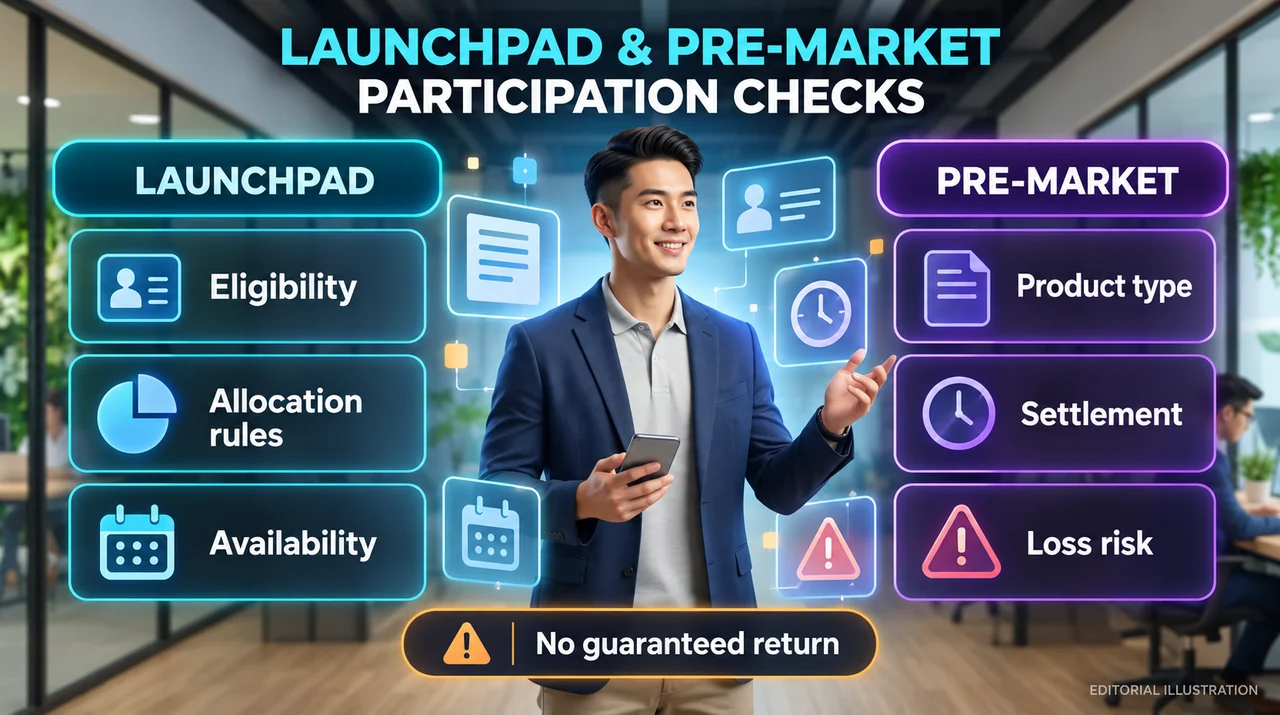
Launchpad allocation and pre-market trading are different activities. Neither ensures an early-mover advantage, a listing gain or stable profit. Identify the actual product and current project terms before relying on a general guide.
Launchpad versus pre-market: distinguish the product
Compare the actual product, execution and settlement rules rather than inferring suitability or a return advantage. OTC delivery and pre-market perpetual futures are not interchangeable. Official OTC rules / Official pre-market futures; checked October 20, 2026.
| Review item | What to verify | Limitation |
|---|---|---|
| Eligibility | Current project and region/account rules | Not open to every account |
| Balance | Which holdings and accounts count | Staking elsewhere need not qualify |
| Allocation | Snapshot, commitment and allocation formula | No guaranteed allocation or return |
| Availability | Delivery, unlock and trading timetable | Listing price or liquidity can change |
| Product | Launchpad versus OTC or perpetual futures | Their obligations are not interchangeable |
Participation checks, not an investor survey
The former 1,000-investor survey had no identifiable dataset or methodology. The following checklist is editorial guidance, not measured preferences or expected returns.
| Check | Where/what to verify | Limit |
|---|---|---|
| Product | Identify Launchpad, OTC delivery or perpetual futures | Their obligations are not interchangeable |
| Eligibility | Current project, account and regional conditions | KYC or holdings alone do not authorize every product |
| Calendar | Registration, delivery and trading notices with time zone | An announcement is not a guaranteed listing or exit |
Three pre-participation checks
These steps check conditions and potential obligations. They do not increase an established probability of profit or allocation.
- Step 1: check current account and regional eligibility, the required identity-verification status, and the specific Launchpad announcement before acquiring or moving assets. Verify eligible balances, snapshot timing and commitment rules. KYC completion or BGB holdings alone do not authorize every product or guarantee allocation. Official individual-verification FAQ; checked October 19, 2026.
- Step 2: identify whether pre-market means OTC delivery trading or perpetual futures. A quote in one is not a prediction or executable hedge in the other.
- Step 3: estimate total exposure, fees, locked collateral and delivery obligations. Splitting capital across projects does not guarantee lower losses.
This article has no verified personal trading comparison. Do not infer that short-term pre-market trading or long-term Launchpad holding has a superior return profile.
Launchpad eligibility and allocation: checks, not winning techniques
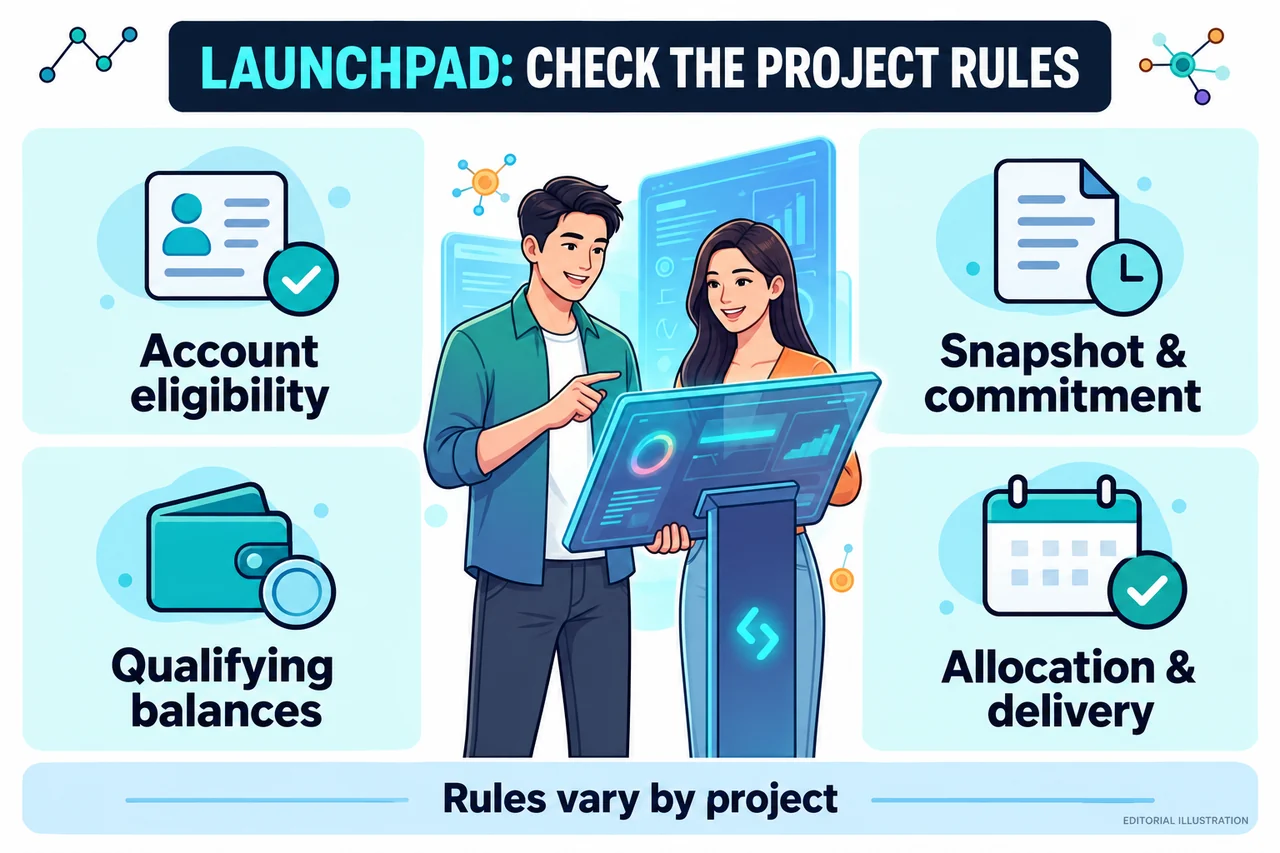
Allocation follows the individual project rules. No secret algorithm, expert strategy or improved winning probability is established here.
1. Which balances qualify during a snapshot?
Launchpad, Launchpool, staking and other products have distinct terms. Confirm which balances count; moving or staking BGB can affect availability or eligibility rather than automatically preserving it. Existing reference (not evidence for a benefit, score or benchmark): Liquidity.
- Eligible balances: use only the accounts and asset categories specified by the current project.
- Snapshot timing: record the published time zone and calculation window; there is no universal 24/7 staking rule.
- Commitment: distinguish a balance snapshot from a manual commitment, lockup or token purchase.
2. Allocation and account restrictions
Do not use subaccounts, family identities or joint account control to bypass participation limits. Historical Launchpad rules have excluded subaccounts; only the current project terms establish eligibility. Historical 2023 Launchpad example; not current eligibility (checked October 18, 2026).
| Check | Where/what to verify | Limit |
|---|---|---|
| Identity | Verification status in the actual account | Do not use other identities to bypass limits |
| Account | Current main/subaccount participation rules | General subaccount access does not prove Launchpad eligibility |
| Region | Current terms, project exclusions and account notices | Language availability is not local authorization |
3. Evidence needed for an allocation comparison
The former six-month study, 2.4-times advantage and group improvements were unsupported. No measured increase in allocation is asserted by this corrected table.
| Check | Where/what to verify | Limit |
|---|---|---|
| Balances | The project's specified assets and qualifying accounts | Other staking products may not count |
| Snapshots | Published window, registration and calculation rules | A historical example is not the current project's rule |
| Allocation | Formula, rounding, commitment and distribution terms | More holdings do not guarantee allocation or profit |
4. Pre-market quotes do not guarantee a hedge
A pre-market position can create its own delivery, collateral or liquidation obligation. No verified evidence supports the former 80% listing-pump probability.
- Order book: visible bids and asks can change; a buy/sell ratio does not establish a future direction.
- Price gap: compare units, delivery mode and circulating supply before interpreting a price difference; no 300% selling rule is established.
- Exit planning: there is no universally stable two-times-return or sell-half rule. Account for costs and possible inability to exit.
This article has no personal profit-taking record. Allocation, listing and pre-market settlement can occur at different times, and orders may not offset each other.
Structural Mechanism and Trading Principles of Bitget Pre-market
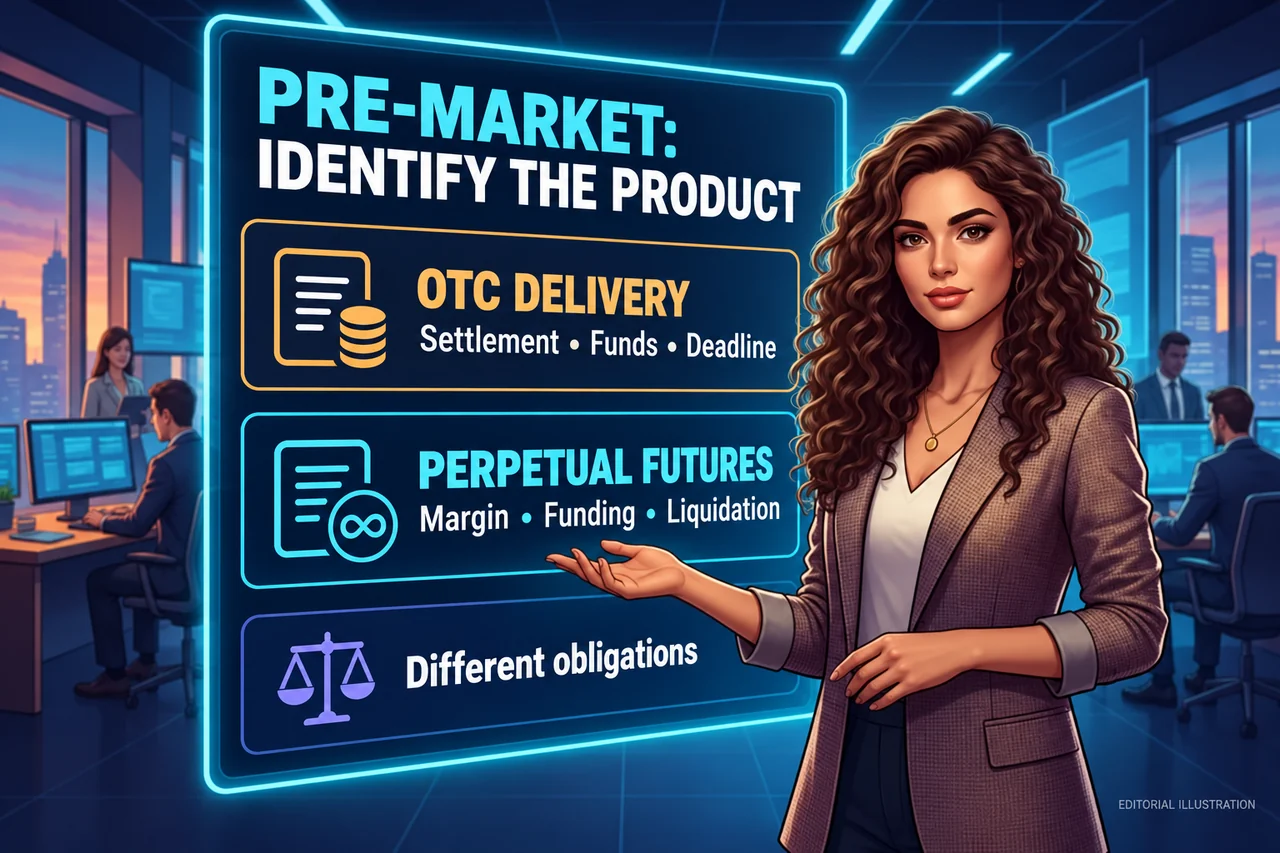
Bitget pre-market OTC delivery trading must be distinguished from pre-market perpetual futures. Confirm the selected product before applying the mechanics below.
The current OTC page describes Coin Settlement and USDT Delivery. Check the selected mode, locked amounts and final delivery deadline. Collateral is an obligation mechanism, not evidence of a favorable purchase price or a guaranteed profit. Existing reference (not evidence for a benefit, score or benchmark): Collateral. Current pre-market delivery rules (checked October 18, 2026).
Comparison of Key Differences: Pre-market vs. General Spot Trading
Liquidity and spreads vary. The table compares mechanics, not a measured claim that all spot markets are liquid or all pre-market positions use identical controls.
| Review item | What to verify | Limitation |
|---|---|---|
| Mode | Coin Settlement, USDT Delivery or futures | Do not mix OTC delivery with liquidation rules |
| Obligation | Required funds/tokens and final deadline | Expected allocation may not be deliverable |
| Default | Exact compensation/refund terms | No universal collateral percentage |
| Price | Order price versus final settlement basis | No guaranteed listing price or hedge |
| Changes | Project and exchange notices | Timing and settlement can change |
| Mode | Coin Settlement, USDT Delivery or futures | Do not mix OTC delivery with liquidation rules |
Checks for a pre-market order
Understand the specific order and settlement mode before accepting an obligation. A completed order need not mean the tokens have already been delivered.
- Step 1: review token supply, unlocks, project documents and current exchange notices. No analysis removes project or listing risk.
- Step 2: inspect executable prices, available order types and depth. A large spread is not proof of a universal platform market-order prohibition.
- Step 3: check the required collateral currency, amount, fees and possible default consequences on the actual order screen.
- Step 4: distinguish token delivery from USDT settlement. Check when funds or tokens must be available and what happens to undelivered orders at the final deadline.
Settlement scenarios instead of an unverified survey
The former community survey and profitability ratings were not substantiated. The table now describes obligations that need verification, not observed strategy success.
| Check | Where/what to verify | Limit |
|---|---|---|
| Coin Settlement | Deliverable token balance and final deadline | Insufficient delivery can trigger default terms |
| USDT Delivery | Settlement basis and locked amounts | This is not delivery of project tokens |
| Perpetual futures | Contract, margin and liquidation rules | Do not apply OTC collateral rules to futures |
Selling an expected allocation before it is available can create a delivery shortfall. An OTC sale and a leveraged short are not interchangeable, and neither is established as an optimal strategy.
Risks to verify: no actual-user frequency study claimed
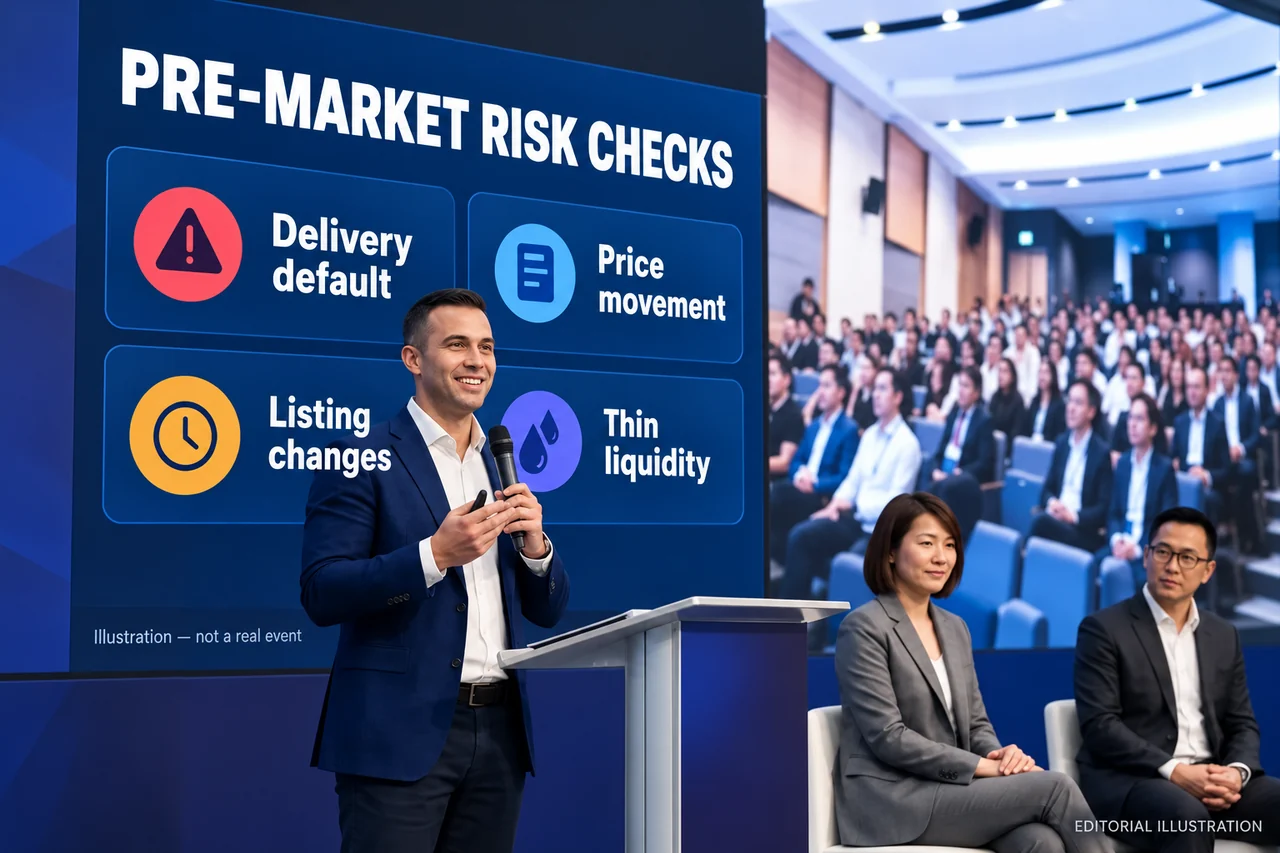
The former actual-user data claim was unsupported. Review delivery default, price movement, listing changes and liquidity separately; this list does not measure their frequency.
1. Seller Default Risk
For Coin Settlement, an insufficient deliverable token balance can lead to default compensation under the specific rules. Do not assume every pre-market product has the same forfeiture or delivery process.
2. Price risk versus futures liquidation risk
OTC delivery default and perpetual-futures liquidation are different mechanisms. The former universal 150% collateral rule was unsupported; check the actual product margin or collateral requirements. Separate pre-market futures guide (checked October 18, 2026).
3. Project Cancellation or Listing Delay
Project schedules and settlement rules may change. Review the specific notice for cancellation, refund and timing conditions; no frequency claim or universal cancellation outcome is established.
4. Risk checklist, not a risk-perception survey
The following categories are explanations, not survey measurements, frequency estimates or user satisfaction ratings.
| Check | Where/what to verify | Limit |
|---|---|---|
| Default | Mode-specific delivery and compensation rules | No universal refund or recovery guarantee |
| Price | Executable quotes, depth and position costs | Liquidity or an available exit is not guaranteed |
| Changes | Latest cancellation, delay and settlement notice | A delay need not cancel every order |
Checks for outstanding product obligations
Thin liquidity can make a planned exit unavailable or costly. This is a risk explanation, not a claim based on personal years of platform observation. Existing reference (not evidence for a benefit, score or benchmark): Bitget.
- Order sizing: splitting an order changes execution timing and exposure; it does not guarantee asset protection.
- Notifications: check which alerts actually exist and whether they are enabled. Delivery or margin obligations remain even if a notification is late or missing.
- Notices: confirm changes through the current official project page; no channel is guaranteed to be first or complete.
Neither Launchpad nor pre-market is established as suitable for beginners. If the delivery or margin obligation is unclear, do not rely on a strategy label to proceed.
Account and product checks instead of unverified user statistics
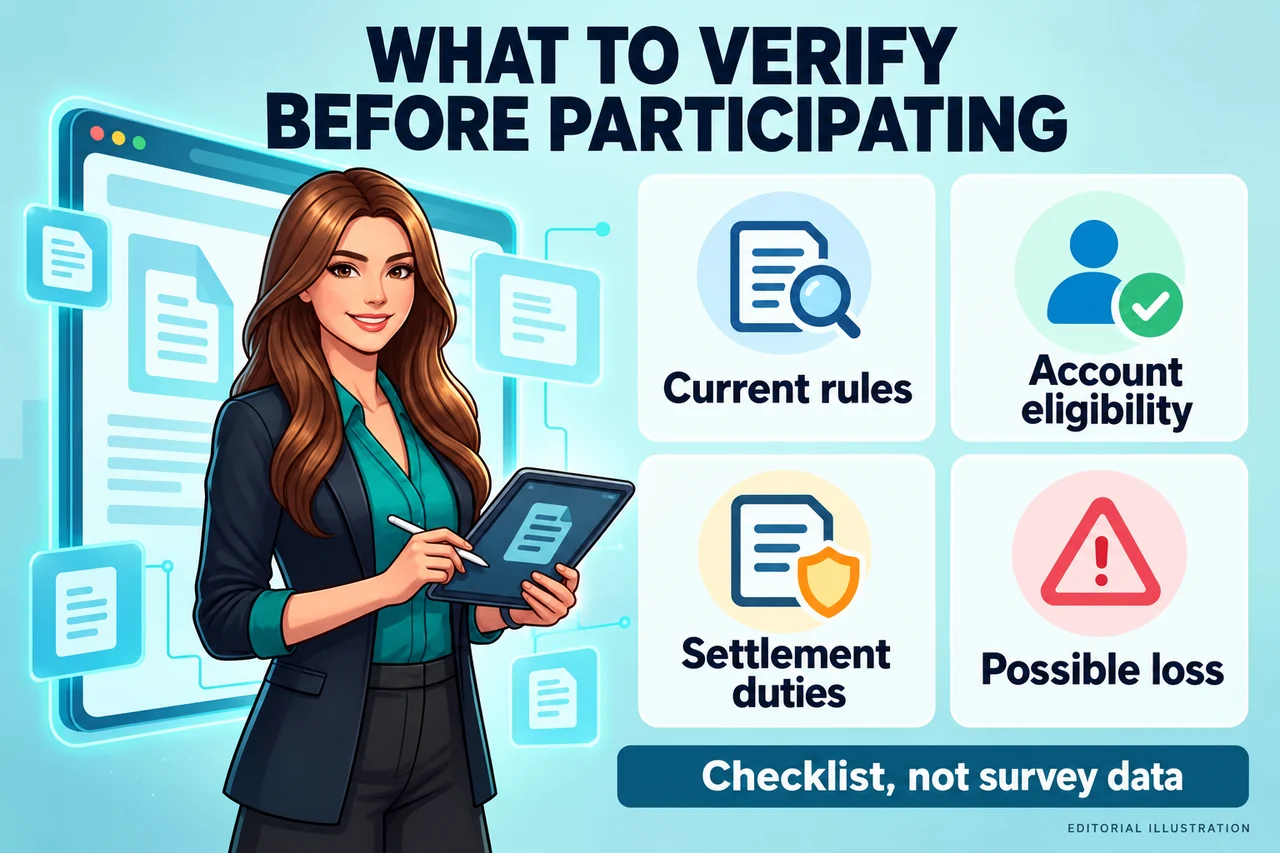
No 1,000-user heavy-user dataset is available for the former balance, turnover and satisfaction claims. The corrected table contains information to check, not a user profile.
| Check | Where/what to verify | Limit |
|---|---|---|
| Locked funds | Available balance versus collateral or commitment | A displayed balance need not be withdrawable |
| Costs | Current fees and, for futures, contract funding terms | No universal fixed fee or funding interval is assumed |
| Evidence | Dated rules and actual account records | These checks are not measured user statistics |
Information needed to compare participation methods
Do not assign investors to reliable or profitable categories from an unsupported survey. Compare their actual product obligations and evidence instead.
- Timing: follow the published snapshot and commitment deadlines, not a claimed one-hour behavior of 65% of users.
- Risk tolerance: no measured 80% user preference is established. Consider the actual possible loss and delivery requirement.
- Product choice: expertise does not establish eligibility, liquidity or positive returns in either product.
Comparison questions rather than measured user-group results
The former loss-defense percentages and satisfaction scores were not supported. The table now identifies checks that apply regardless of claimed experience.
| Check | Where/what to verify | Limit |
|---|---|---|
| Before an order | Supported order type, product and obligation | A strategy label does not establish suitability |
| During an obligation | Delivery deadline or margin and notices | Alerts do not replace the user's obligations |
| After settlement | Actual fills, fees and settlement records | A record does not prove repeatable returns |
Four record-keeping checks
No dataset establishes a profitable top-5% user group or a procedure that reliably reduces loss. These are documentation steps only.
- Exposure: record how much is committed, locked or at risk. No fixed 20% allocation is recommended.
- Record the source date, supply unit and unlock conditions. A whitepaper or circulating-supply figure is not a reliable dump prediction.
- Position record: distinguish an OTC delivery obligation from any separate futures exposure.
- Retain fills, fees and settlement records for reconciliation. A trading journal does not establish expertise, repeatable profitability or a reason to enter another project.
The former statistical conclusions should not be relied on. Product rules, eligibility and executable account records are more useful than invented user-preference numbers.
Korean access and security: conditions, not availability guarantees

Korean-language content does not establish Korean registration status, KRW banking access or permission to use a product. KYC approval is not a substitute for current account, residence and product eligibility. Published country lists can differ between the terms and help pages; absence from one list does not prove access is permitted. Check current terms, project rules, account notices and applicable local restrictions; do not bypass restrictions. Official eligibility terms; checked October 19, 2026.
Essential Security Settings (Security First)
Review the security and recovery methods supported by your account and protect recovery material. The checks below are not a universal three-step procedure that guarantees account safety or recovery. Official phishing precautions / Official account recovery; checked October 20, 2026.
- Two-factor authentication: review supported account security methods and store recovery material privately. No single method prevents every account compromise.
- Anti-phishing code: it is one signal, not a guarantee that an email or link is genuine. Verify the domain independently.
- Withdrawal allowlist: review how it is enforced and protect account recovery settings; an approved address can still be wrong or compromised.
Transfer checks, not recommended transfer coins
No TRX, XRP or ETH route is always cheapest or fastest. Check the current withdrawal fee and net amount for the selected asset and network; include trading fees, spread and price changes if conversion is needed. Sending-platform review, blockchain confirmations and receiving-platform credit are separate stages with no guaranteed completion time. Official fees / Official withdrawal status; checked October 20, 2026.
| Review item | What to verify | Limitation | Evidence |
|---|---|---|---|
| Network | Exact supported chain at both ends | Same token symbol is not compatibility | Current official terms and actual account record |
| Destination | Address and required memo/tag | Saved or approved addresses can still be wrong | Current official terms and actual account record |
| Cost/time | Live fee, confirmations and account reviews | No always-fastest or cheapest coin | Current official terms and actual account record |
Transfer and order limitations
Verify the exact asset, chain, address, required memo/tag and current deposit/withdrawal support at both ends. TRC20 or ERC20 labels alone do not establish compatibility. Reversal or recovery of a wrong transfer is not guaranteed; retain the TxID and consult the applicable official support procedure. Bitget internal transfers to another Bitget user are a separate function, not on-chain withdrawals to an external exchange. Official network and withdrawal checks / Official internal transfer; checked October 20, 2026.
Confirm the order types of the selected pre-market product. A limit order does not guarantee execution and does not remove delivery or margin risk.
Comprehensive Summary and FAQ
Key Summary
Launchpad allocation is project-specific. Pre-market quotes do not ensure listing profit, and account security does not establish product eligibility or eliminate market losses.
Frequently Asked Questions (FAQ)
- Q: Does staking BGB always increase Launchpad allocation? A: No. The current project rules determine eligible balances, snapshots and commitments; other staking products may not count.
- Q: What must be checked before pre-market trading? A: Identify OTC delivery or perpetual futures, then verify the selected settlement, collateral or margin rules, fees and deadlines.
- Q: Does Korean-language content prove Korean service availability? A: No. Language availability does not establish regional access, local registration or account/product eligibility.
- Q: How should a suspected account compromise be handled? A: Use official support and a separate trusted device, preserve evidence, review sessions and keys, and follow the supported security recovery process. Recovery is not guaranteed.
Official sources and limits of this correction
Sources checked October 18, 2026. Historical documents are identified as such; they do not establish a current promotion or eligibility. Account, product and regional conditions can change.
- Current pre-market delivery modes
- Separate pre-market futures
- Historical Launchpad example, May 2023; not current eligibility
- Eligibility terms
BitQED is an independent informational site and may receive affiliate commissions through existing partner links. No fixed user benefit is established by those links. Cryptocurrency, leverage, custody, stablecoin, technical and regulatory risks remain. This article is not investment, legal or tax advice.