Bitget’s standard crypto futures rates are 0.02% maker and 0.06% taker; the standard spot rate is 0.1% on either side. Fees use the executed trade value, not just margin. Product, VIP and account conditions can change the actual rate; funding and withdrawal costs are separate. Bitget — Trading Fees FAQ
Limited check: 26 October 2026 — standard rates, reading layout and illustration explanations only. The earlier comprehensive-review and profit-sharing verification dates below retain their original scope.
Original comprehensive review: August 12, 2026. Selected source-link verification: October 18, 2026 (standard fees, BGB scope and funding intervals only).
Bitget trading costs are not determined by a single fee.
Depending on how you trade, your total cost can include:
- Spot maker and taker fees
- Futures maker and taker fees
- Funding fees on perpetual futures
- Copy trading profit sharing
- VIP or account-specific fee rates
- BGB fee deductions
- Withdrawal fees
- Slippage and spread
For most users, the most important starting point is Bitget’s standard trading fee schedule.
As of this review, Bitget publicly lists standard crypto futures fees of 0.02% for Maker orders and 0.06% for Taker orders. Official fee FAQ (source checked October 18, 2026; verify current account/product terms).
Standard spot trading uses a 0.1% Maker / 0.1% Taker base rate.
Bitget also states that eligible spot and margin users can use BGB to deduct trading fees and receive a 20% discount.
This guide explains how those fees work, how to calculate the real cost of a trade, and which fee-reduction methods are actually documented by Bitget.
Key Takeaways
- Standard crypto futures fee: Maker 0.02%, Taker 0.06%.
- Standard spot fee: Maker 0.1%, Taker 0.1%.
- BGB deduction: Bitget states that BGB can provide a 20% fee discount for eligible spot and margin trading.
- Affiliate and referral benefits are not the same thing as the public standard fee schedule.
- Available rebate settings can vary by account, region, campaign and affiliate tier.
- Funding fees are separate from trading fees.
- Although an eight-hour funding cycle is common, Bitget can change the funding interval for individual perpetual contracts.
- Copy trading can add profit-sharing costs.
- Bitget copy trading profit sharing depends on the product, version and portfolio type; no single percentage is a universal ceiling.
- The cheapest way to trade is not determined by the headline fee alone. Order type, turnover, leverage, funding and slippage can matter more.
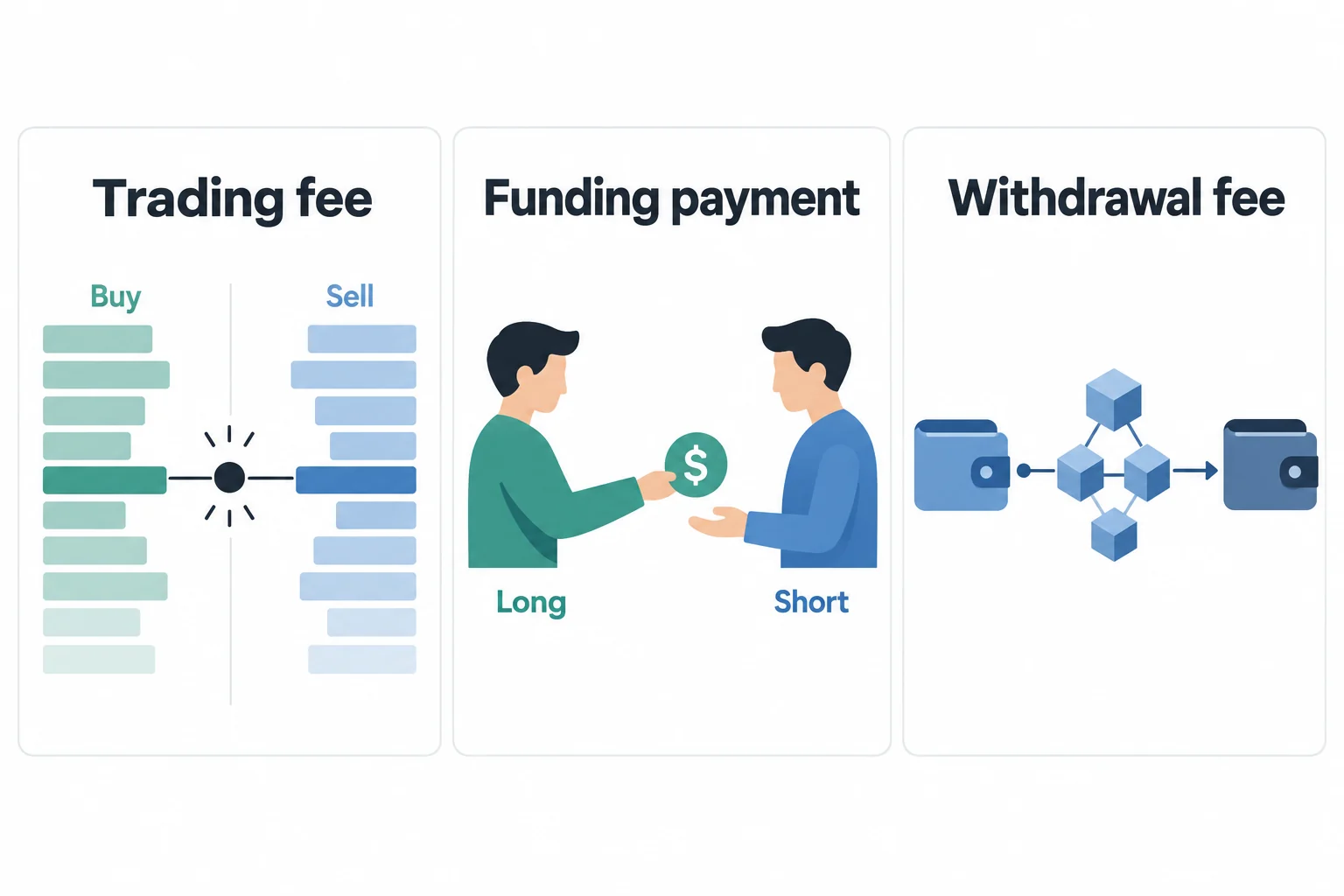
Trading rates and your account’s actual fees
Bitget Futures Fees in 2026
For standard non-VIP crypto futures trading, the public base schedule is:
| Order Type | Standard Fee | Fee per $10,000 Traded | Fee per $100,000 Traded |
|---|---|---|---|
| Maker | 0.02% | $2 | $20 |
| Taker | 0.06% | $6 | $60 |
Particular products, VIP levels, market-maker programs and promotions can use different rates.
Futures Fee Formula
The basic calculation is: Trading Fee = Position Value × Fee Rate
For example, a 100,000 USDT futures position executed as a Taker:
100,000 × 0.06% = 60 USDT
If the position is later closed as another Taker order at the same notional value:
60 + 60 = 120 USDT
A full open-and-close cycle would therefore cost 120 USDT in trading fees, before funding, slippage or other costs.
Bitget Spot Trading Fees
Bitget’s public spot fee schedule lists the base rate as:
| Order Type | Standard Spot Fee |
|---|---|
| Maker | 0.1% |
| Taker | 0.1% |
For example, a 10,000 USDT spot purchase at a 0.1% fee costs:
10,000 × 0.1% = 10 USDT
A later sale of another 10,000 USDT at the same base rate would cost another:
10 USDT
Total: 20 USDT
Orders, execution, leverage and slippage
How Bitget Trading Fees Work
Bitget uses a Maker/Taker fee model.
The distinction matters because a trader who repeatedly executes immediately against the order book can pay substantially more than a trader whose orders provide liquidity.
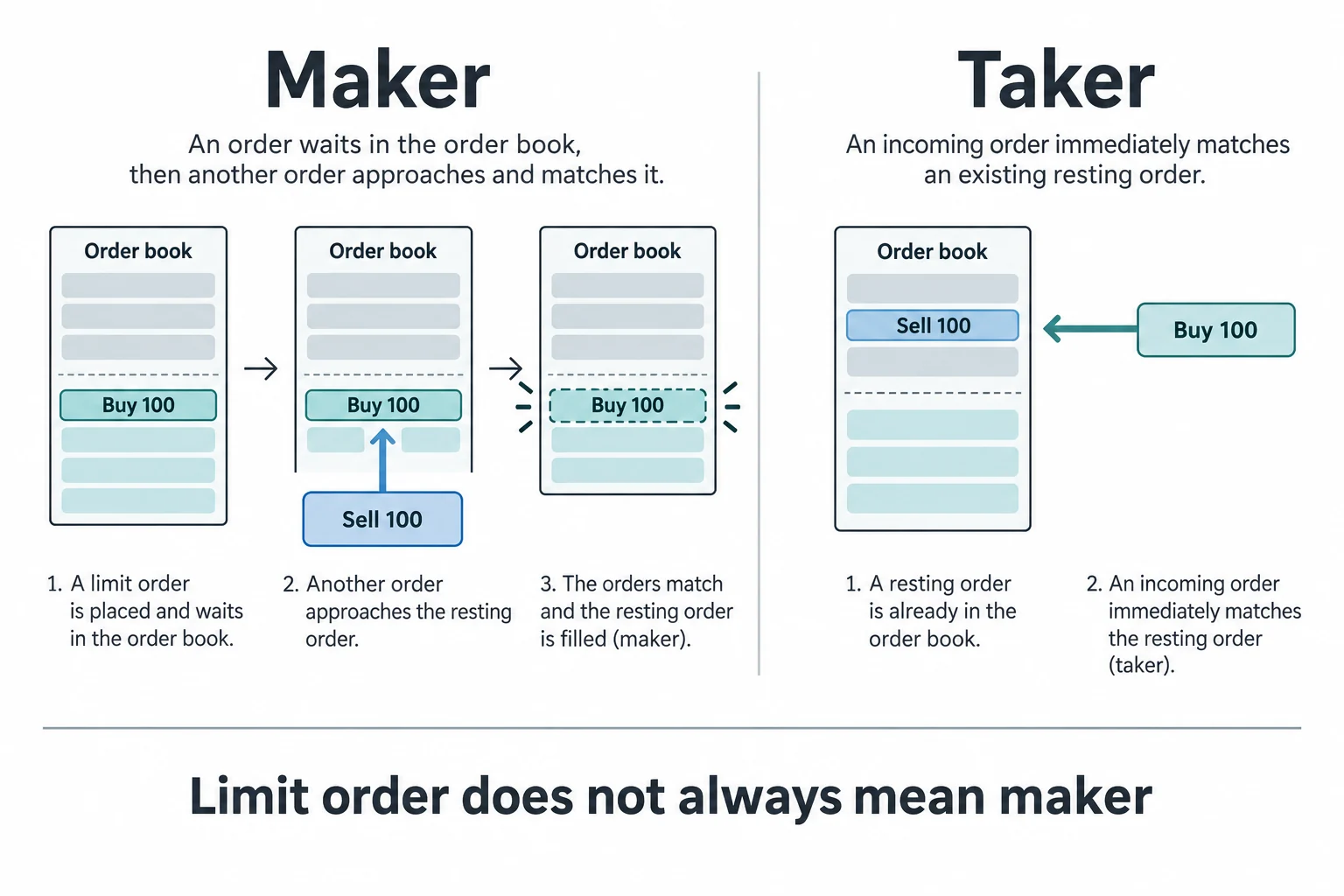
Maker Orders
A Maker order adds liquidity to the order book.
A typical example is a limit order that does not execute immediately.
If BTC is trading at 100,000 USDT and you place a buy limit order at 99,000 USDT, the order can remain in the book until another participant trades against it.
For standard crypto futures, Bitget’s published Maker fee is:
0.02%
Taker Orders
A Taker order removes existing liquidity.
Market orders are the clearest example, although a marketable limit order can also become a Taker order if it executes immediately.
For standard crypto futures, Bitget’s published Taker fee is:
0.06%
That means the standard Taker rate is three times the standard Maker rate.
For active futures traders, this difference can become significant.
Does Leverage Reduce the Trading Fee?
No.
This is one of the most important points for new futures traders.
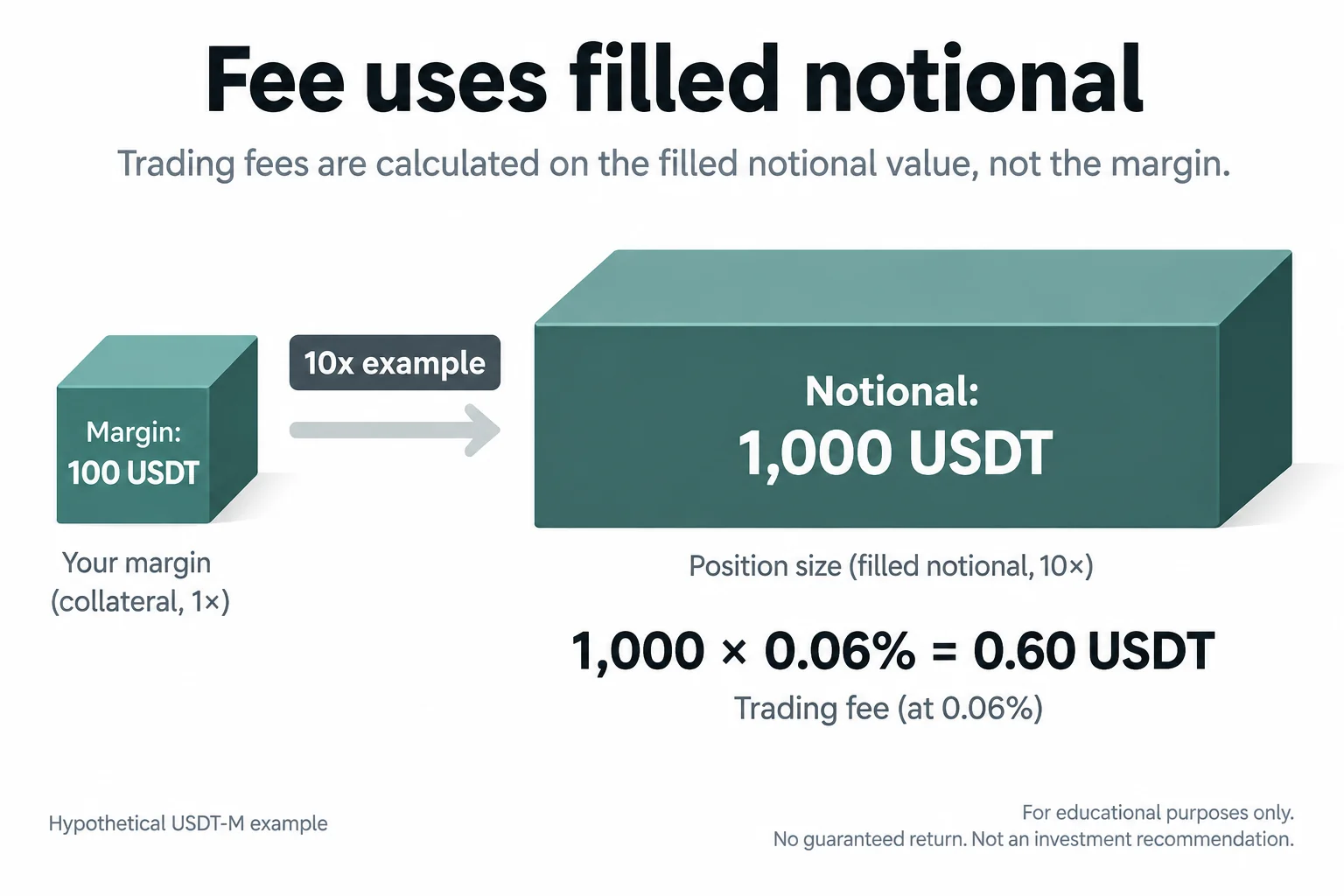
Trading fees are generally calculated from the position notional, not merely the margin deposited.
Suppose you use:
- Margin: 10,000 USDT
- Leverage: 10x
- Position value: 100,000 USDT
At the standard Taker rate: 100,000 × 0.06% = 60 USDT
The fee is based on the 100,000 USDT position.
Higher leverage therefore does not make the trading fee cheaper.
Instead, leverage allows a larger position to be controlled with less margin, which can make fees and profit or loss much larger relative to the capital committed.
Maker Orders Are Not Automatically Better
Lower fees do not automatically mean better execution.
A Maker order may:
- Fail to fill
- Fill only partially
- Miss a fast market move
- Force the trader to chase the price later
A Taker order costs more at the standard rate but provides immediate execution against available liquidity.
Therefore, the relevant question is not:
“How do I always pay the Maker fee?”
It is:
“Is the lower Maker fee worth the execution risk for this trade?”
For high-frequency and systematic strategies, the distinction can materially affect results.
Slippage Is a Trading Cost Even Though It Is Not a Fee
Suppose BTC is quoted at: 100,000 USDT
You submit a large market buy but your average execution price becomes:
100,050 USDT
The difference is not listed as a Bitget trading fee.
It is execution slippage.
For a sufficiently large order, slippage can exceed the exchange fee itself.
Total trading cost should therefore be considered as: Trading Fee + Funding ± Slippage + Spread + Other Applicable Costs
not simply: Maker/Taker Fee
BGB, VIP and referral conditions
BGB Fee Discount: What Is Officially Documented?
Account-type distinction, checked 28 October 2026: the UTA FAQ dated 21 September 2026 describes a 20% BGB fee-payment discount for eligible spot and futures trades when enabled and sufficiently funded. This is a UTA-specific condition, not a discount guaranteed for every classic account or futures product. Check your account mode and actual fee setting. UTA account and fee conditions.
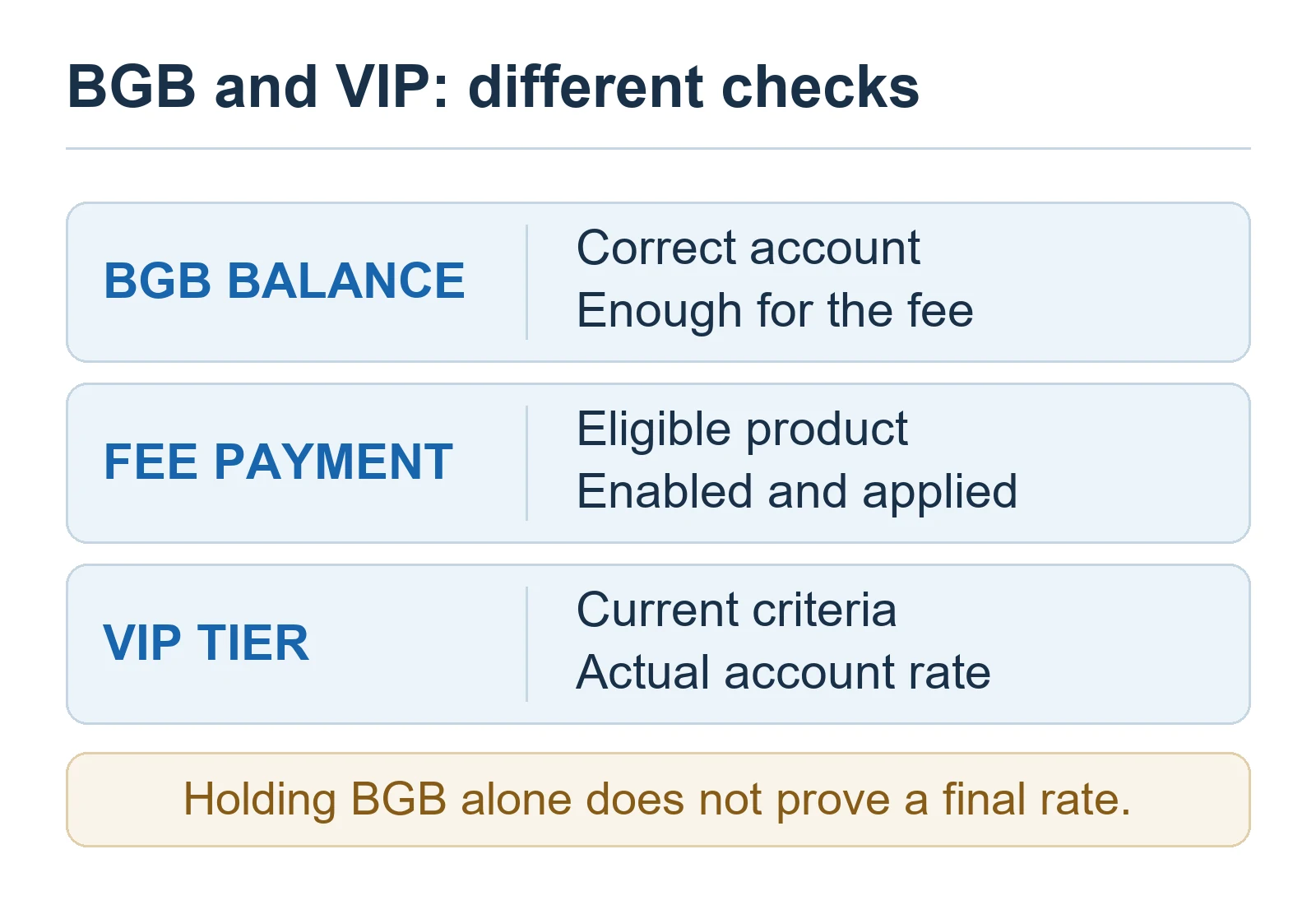
Bitget states that users can use BGB to deduct transaction fees for eligible spot and margin trading and receive a 20% discount. Official BGB spot deduction guide (source checked October 18, 2026; verify current account/product terms).
Using the standard 0.1% spot rate as the base: 0.1% × 80% = 0.08%
So a 10,000 USDT spot trade would theoretically cost:
Standard: 10,000 × 0.1% = 10 USDT
With a 20% reduction: 10,000 × 0.08% = 8 USDT
Savings: 2 USDT
For 1,000,000 USDT of cumulative eligible spot turnover:
Standard: 1,000,000 × 0.1% = 1,000 USDT
At an effective 0.08%: 1,000,000 × 0.08% = 800 USDT
Difference: 200 USDT
The important limitation is that Bitget’s current spot fee documentation explicitly describes the BGB deduction for spot and margin trading. Official spot-margin deduction policy (source checked October 18, 2026; verify current account/product terms).
Users should not assume the same 20% mechanism automatically applies to every futures product.
VIP Fees Are Separate from Referral Benefits
Bitget also operates a VIP fee structure for qualifying users.
VIP pricing can reduce trading fees according to the applicable account qualification criteria.
Professional and institutional users may also fall under separate PRO or market-maker programs.
The practical point is: VIP fee ≠ referral rebate ≠ affiliate commission.
They are separate mechanisms.
A high-volume trader should check the actual Fee Schedule shown inside the account rather than assume the public base rate remains the final rate.
Bitget Referral Code BITGETDC: What It Does and What It Does Not Guarantee
How to verify a referral code and its conditions
BitQED uses the Bitget partner referral code: BITGETDC
Partner registration link:
If you are creating a new Bitget account through BitQED, verify that BITGETDC appears in the referral field before completing registration.
Bitget’s affiliate system allows partners to create referral codes and links and, where permitted, configure rebate options.
Available settings can vary depending on factors such as account permissions, region, campaign and affiliate tier.
Therefore, it is important to distinguish between: Bitget’s public standard trading fee
and
an account-specific referral, rebate or promotional benefit.
Bitget’s Affiliate Program Policy states that affiliates may earn up to 50% of eligible trading fees generated by referrals.
This refers to the affiliate commission structure and should not automatically be interpreted as a universal 50% trading-fee discount for every referred user.
What Should a New User Do?
Use the partner registration page and review the benefits actually displayed by Bitget before completing registration.
Open Bitget Partner Registration — BITGETDC
Affiliate disclosure: This is a partner link. BitQED may receive compensation from qualifying registrations or trading activity. Referral benefits, fee rebates, rewards and promotional terms can vary by account, jurisdiction and campaign. Confirm the final terms displayed by Bitget.
Is a Referral Discount the Same as an Affiliate Commission?
No.
This distinction is especially important because the terms are often mixed together on crypto websites.
Bitget’s affiliate program can provide affiliates with commissions generated from eligible referral activity.
That does not automatically mean:
Standard Futures Taker 0.06% ÷ 2 = guaranteed user rate 0.03%.
Referral rebate settings and affiliate commissions are separate concepts.
Unless a specific end-user rebate is explicitly confirmed for a referral code or displayed during registration, a fixed “after referral” trading-fee rate should not be assumed.
This is why BitQED separates:
- Official base fee
- BGB discount
- VIP fee
- Affiliate commission
- Referral rebate
- Temporary promotion
instead of combining them into one headline percentage.
Funding: amounts, intervals and payment direction
Funding Fees: The Cost Many Futures Traders Underestimate
Trading fees are only one part of futures trading costs.
Perpetual futures also use funding payments to help keep the contract price aligned with the underlying market.
Funding is generally exchanged between long and short position holders rather than being charged as a conventional trading fee.
A simplified formula is: Funding Payment = Position Value × Funding Rate
For example:
Position value: 100,000 USDT
Funding rate: 0.01%
Funding payment: 100,000 × 0.01% = 10 USDT
If you remain in a position across multiple funding settlements, those payments can accumulate.
Is Bitget Funding Always Every 8 Hours?
No.
This is an important correction to older guides.
An eight-hour funding schedule is common under standard conditions.
However, Bitget can change the funding interval for individual perpetual contracts. Official funding-interval update (source checked October 18, 2026; verify current account/product terms).
Depending on the contract and market conditions, funding intervals can include:
- 1 hour
- 4 hours
- 8 hours
Therefore, do not assume every Bitget perpetual contract settles funding exactly three times per day.
Check the funding information shown for the specific contract before entering a position.
Why Funding Can Cost More Than the Trading Fee
Consider a 100,000 USDT position.
Taker Entry Fee
100,000 × 0.06% = 60 USDT
Suppose the position remains open across several funding settlements with a positive funding rate.
At a hypothetical 0.03% funding rate: 100,000 × 0.03% = 30 USDT
Two such funding payments would equal: 60 USDT
That is already equivalent to the initial Taker fee.
This is why comparing exchanges purely by Maker/Taker rates can be misleading for traders who hold leveraged positions for extended periods.
Copy trading profit sharing by product and version
Copy Trading Fees and Profit Sharing
Copy trading can involve more than ordinary trading fees.
Under Bitget’s current futures copy trading system, a copier can incur normal futures trading costs while an Elite Trader may also receive a share of eligible copier profits.
Profit-sharing rates differ by product and version. The following official documents were checked on October 24, 2026 (KST); their publication dates are not guarantees of the rate available to a particular account.
Official-source inconsistency: the new futures guide states 0%–10% in its settings and FAQ, but its settlement examples use 12% and 15%. BitQED cannot resolve that discrepancy from these documents alone.
Check the actual ratio on the trader profile and the applicable portfolio rules and settlement screen. If they conflict with the documentation, ask official support before relying on a rate. A private invitation code grants portfolio access under its conditions; it does not itself establish a fee discount.
The new futures guide describes settlement of new eligible profits relative to already settled profits (High Water Mark). Its regular cycle requires all copy-account positions to be closed; open positions defer eligibility. Do not assume identical settlement rules for every product or version.
Example
Hypothetical calculation only: suppose the copier has the following eligible profit and the selected portfolio actually applies the assumed 10% ratio. This is not a recommended or universal rate:
500 USDT eligible profit
and the applicable Elite Trader share is: 10%
Potential profit share: 500 × 10% = 50 USDT
This amount is separate from the normal trading fees incurred while the copied positions are executed.
Always check the actual profit-sharing ratio shown on the trader’s copy trading page.
Do Losing Copy Trades Pay Profit Share?
In the new futures guide, profit sharing concerns eligible profits, not a fixed charge on every trade; other products must be checked under their own rules.
Losses do not create profit to share.
For that new futures settlement model, previously settled profit is excluded from new eligible profit. This does not remove trading fees, funding costs or market-loss risk.
Therefore, the statement:
“Copy trading always charges 10% of profitable trades.”
is too broad.
The actual trader ratio, settlement status and applicable rules should be checked for the specific copy portfolio.
Trading cost calculations and examples
Real Trading Cost Examples
The following calculations use Bitget’s public standard crypto futures rates, not an assumed referral discount.
Example A — $10,000 Position
Maker Entry + Maker Exit
Entry: $10,000 × 0.02% = $2
Exit: $10,000 × 0.02% = $2
Total: $4
Taker Entry + Taker Exit
Entry: $10,000 × 0.06% = $6
Exit: $10,000 × 0.06% = $6
Total: $12
Difference: $8
Example B — $100,000 Position
Maker + Maker
$20 + $20 = $40
Taker + Taker
$60 + $60 = $120
Difference: $80
Example C — $1,000,000 Position
Maker + Maker
$200 + $200 = $400
Taker + Taker
$600 + $600 = $1,200
Difference: $800
For high-turnover traders, order execution style can have a major effect on total costs.
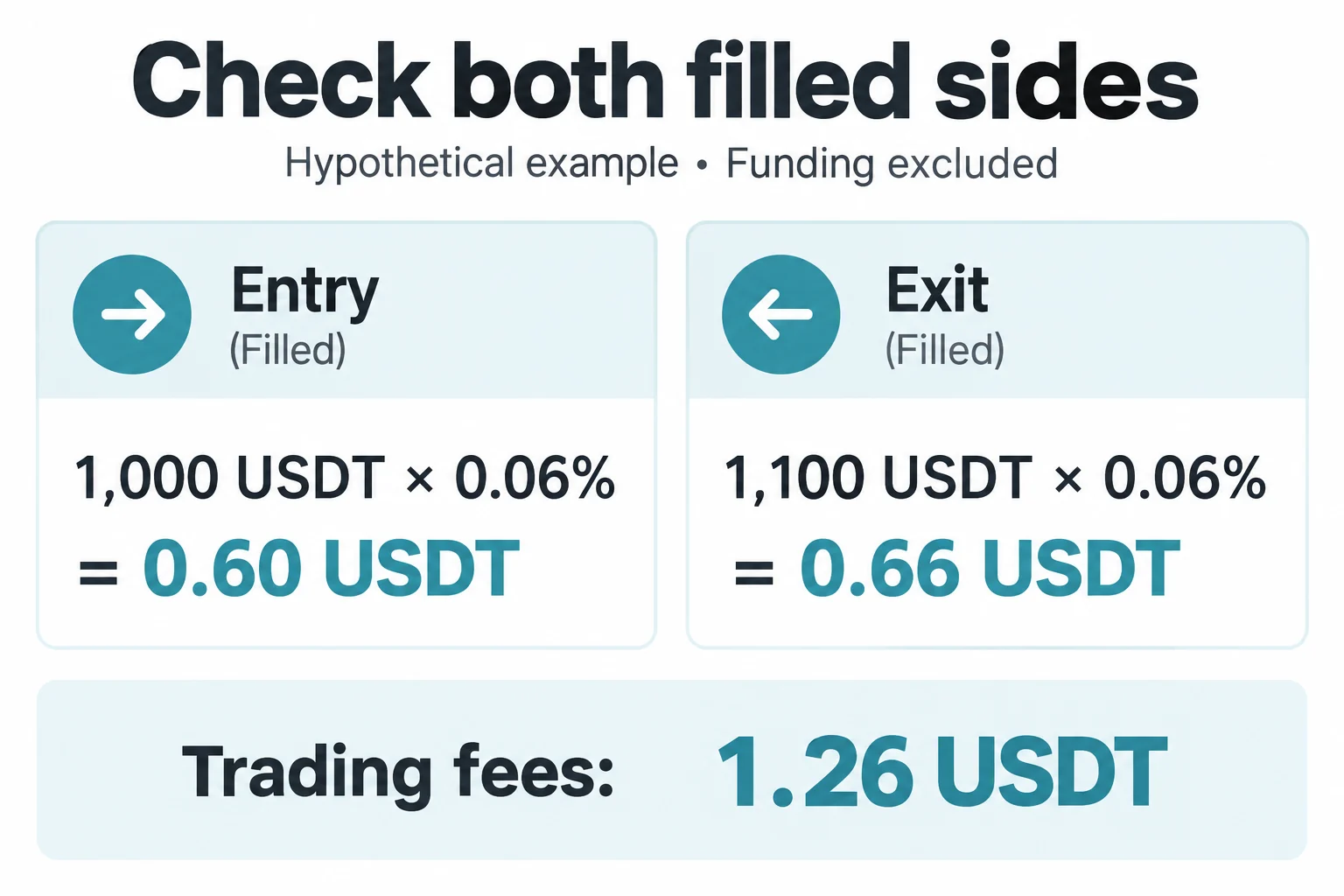
Bitget Fee Calculation Examples
You can calculate a basic trading fee using: Position Value × Trading Fee Rate
Futures Maker
Position Value × 0.0002
Futures Taker
Position Value × 0.0006
Standard Spot
Trade Value × 0.001
Examples:
| Trade Value | Futures Maker | Futures Taker | Spot Base Fee |
|---|---|---|---|
| $1,000 | $0.20 | $0.60 | $1.00 |
| $10,000 | $2 | $6 | $10 |
| $50,000 | $10 | $30 | $50 |
| $100,000 | $20 | $60 | $100 |
| $500,000 | $100 | $300 | $500 |
| $1,000,000 | $200 | $600 | $1,000 |
These values represent one transaction side only.
If you open and later close a position, trading fees can be charged on both transactions.
How Much Do 100 Trades Cost?
Suppose a trader repeatedly executes a 100,000 USDT futures position.
If one “trade” means one entry and one exit:
Taker on Both Sides
Cost per round trip: 120 USDT
100 round trips: 12,000 USDT
Maker on Both Sides
Cost per round trip: 40 USDT
100 round trips: 4,000 USDT
Difference: 8,000 USDT
This is a simplified illustration and does not include:
- Funding
- Slippage
- Different exit prices
- VIP pricing
- Account-specific discounts
- Promotions
- Partial fills
But it shows why execution method can matter more than traders initially expect.
Deposits, withdrawals and account-record checks
Deposit and Withdrawal Costs
Trading fees should also be separated from blockchain transfer costs.
Deposit and withdrawal conditions can vary by asset and network, and withdrawal fees can change with network conditions.
Because of that, fixed statements such as:
- “TRC-20 always costs $1”
- “XRP always costs $0.20”
- “ERC-20 is always expensive”
should not be treated as permanent fee data.
Before transferring funds, check the withdrawal screen for the actual:
- Network
- Minimum withdrawal
- Withdrawal fee
- Required memo or tag
- Estimated arrival conditions
The cheapest network is only useful if the destination platform supports the exact same asset and network.
The Most Practical Ways to Reduce Bitget Fees
There is no single universal “maximum discount” method.
Instead, users can reduce trading costs through several separate mechanisms.
1. Use Maker Orders When Execution Conditions Justify It
Standard futures:
- Maker: 0.02%
- Taker: 0.06%
2. Use BGB Fee Deduction Where Officially Supported
Bitget documents a 20% fee discount for eligible spot and margin trades when BGB fee deduction is enabled.
3. Check Your VIP Level
High-volume or qualifying accounts can receive different rates under Bitget’s VIP framework.
4. Review Referral Benefits Before Registration
Affiliate links can include account-specific or campaign-specific benefits, but they should not be assumed to provide a fixed universal discount.
5. Avoid Unnecessary Turnover
A lower percentage fee cannot compensate for excessive trading frequency.
6. Monitor Funding Before Holding Perpetual Futures
Funding can become a major cost during crowded markets, and funding intervals can vary by contract.
Final Assessment: What Actually Determines Your Bitget Trading Cost?
The most useful way to understand Bitget fees is to separate each cost rather than search for one headline discount percentage.
For a typical trader, the main variables are:
- Spot or futures
- Maker or Taker execution
- Position or trade value
- Trading frequency
- Funding payments
- VIP status
- BGB deduction where supported
- Account-specific referral or promotional terms
- Slippage
- Withdrawal network
Bitget’s public standard pricing remains straightforward:
Standard crypto futures
- Maker: 0.02%
- Taker: 0.06%
Standard spot
- Maker: 0.1%
- Taker: 0.1%
But those numbers alone do not determine your final trading cost.
A disciplined trader should check the actual fee schedule displayed in the account, the current funding rate and interval for the relevant contract, and any referral or VIP benefits that actually apply.
If you are opening a new account through BitQED, you can use the partner link below and verify the current terms directly on Bitget.
Referral Code: BITGETDC
Affiliate Disclosure: BitQED may receive compensation from qualifying registrations or trading activity through this link. Referral rewards, rebates, fee benefits and promotions can change by account, jurisdiction and campaign. Always confirm the terms displayed by Bitget.
Frequently asked questions and sources
Frequently Asked Questions
What Are Bitget’s Standard Futures Trading Fees in 2026?
Bitget publicly lists standard crypto futures rates of: 0.02% Maker and 0.06% Taker
Actual account rates can differ depending on VIP status, product, promotions or other applicable conditions.
What Are Bitget’s Standard Spot Fees?
The public base spot rate is: 0.1% Maker and 0.1% Taker
Does Paying With BGB Reduce Fees?
Bitget states that eligible spot and margin users can use BGB to deduct trading fees and receive a 20% discount.
Does BITGETDC Guarantee a 50% Trading-Fee Discount?
No universal 50% end-user fee reduction should be assumed from the affiliate code alone.
Bitget’s references to affiliate commission rates and end-user referral rebates are separate concepts.
Referral benefits can vary according to the partner program, account, jurisdiction and campaign.
What Is the BitQED Bitget Referral Code?
The BitQED partner code is: BITGETDC
Partner link:
Check the code and current benefits directly on the Bitget registration screen before completing registration.
Can I Add a Referral Code After Registering?
Eligibility can depend on the account’s existing status and Bitget’s current rules.
Do not create duplicate accounts or use alternative identity documents solely to obtain a referral benefit.
Existing users should confirm available options directly with Bitget Support.
Is Funding Always Charged Every Eight Hours?
No.
Eight hours is a common funding interval, but individual perpetual contracts can use different schedules, including shorter intervals.
Always check the funding schedule of the specific contract.
Does Bitget Charge the Funding Fee Itself?
Funding on perpetual futures is generally structured as a payment exchanged between users holding opposing positions rather than as a normal exchange trading fee.
What Is the Copy Trading Profit-Share Rate?
There is no universal Bitget copy-trading profit-share rate. The new futures guide states 0%–10% but contains inconsistent 12%/15% examples; the earlier tier notice lists maxima of 10%–20% excluding private mode; the private futures guide permits 0%–50%. Check the actual trader profile and product/version settlement rules; see the dated official-source comparison in the Copy trading profit sharing by product and version section.
Is Maker Always Cheaper Than Taker?
The standard Maker fee is lower.
However, Maker orders may not execute or may execute only partially.
Execution quality, slippage and missed opportunities also matter.
Sources & Data Review
Original comprehensive review: August 12, 2026. Selected source-link verification: October 18, 2026 (standard fees, BGB scope and funding intervals only).
Key information in this guide was reviewed against Bitget’s official documentation covering:
- Standard crypto futures trading fees
- Spot trading fees
- BGB fee deduction
- Affiliate and referral systems
- Futures funding
- Funding interval adjustments
- Copy trading profit sharing
- VIP fee structures
Official Bitget references: